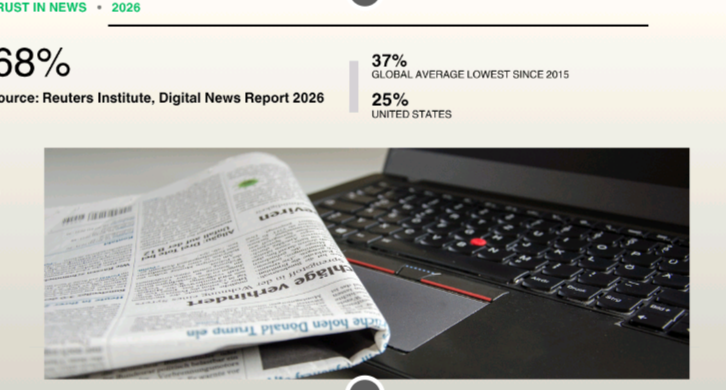
Trust in the news media has just fallen to its lowest point since anyone started measuring it. The Reuters Institute’s own Digital News Report 2026, built on responses across 48 markets, found trust dropping in 29 of them, with the global average now at 37%, the lowest level the Institute has recorded since it began tracking the metric in 2015.
Two markets did not get that memo. Kenya and Nigeria recorded overall trust of 68%, joint highest of all 48 countries surveyed. Both sit well ahead of the United States, where the same report puts overall trust at 25%.
That is the story worth telling, and almost nobody outside Africa is telling it.
Legacy Media Is Shrinking While Trust Falls With It
The pattern elsewhere on the continent shows what happens without that trust. South Africa’s overall trust score fell 5 percentage points to 50%, dropping the country from second place among all markets in 2022 to ninth this year. The country’s newsroom economics tell the same story. The same report notes that the Mail & Guardian cut 12 people from an already small newsroom of 25 permanent staff, on top of the Media24 print shutdowns that began in 2024.
Shrinking newsrooms and falling trust move together. Kenya and Nigeria show what moving in the other direction looks like.
The Winning Newsrooms Are Digital Natives, Not Legacy Broadcasters
The detail that matters is which brands are actually earning that trust. In Kenya’s online news category, TUKO.co.ke leads with a weekly reach of 62%, ahead of Citizen TV online, Kenyans.co.ke and Daily Nation online. In Nigeria, the Reuters Institute’s own country page names Legit.ng among the digital-born brands that continue to grow, particularly among younger audiences, even as the country’s press freedom ranking, its advertising economics and its cybercrime laws all remain under strain.
These are not state broadcasters or century-old newspapers. They are commercial, digital-first newsrooms competing for the same distracted, platform-hopping audience as everyone else, and winning its trust rather than assuming it.
We Built Trust the Same Way Everywhere Else Is Losing It
None of this happens by accident. At TUKO.co.ke, editorial judgement runs through EditorialEye, an in-house AI assistant trained on our own editorial guides, SEO standards and ethical frameworks. It checks, flags and recommends, but it never writes, and every final decision sits with a human editor, a distinction that matters when 63% of Kenyan media consumers, per the Media Council of Kenya’s own State of the Media 2025 report, say they cannot tell AI-generated content from traditional reporting.
At Legit.ng, the same instinct shows up in specific stories, not just policy documents. When a claim spread widely this year that South Africa had denied BUA Group chairman Abdul Samad Rabiu a visa, FactCheckAfrica rated the claim misleading: he had in fact been refused entry over a visa that had expired the day before, not a rejected application, and the verification named Legit.ng among the outlets that had reported it accurately from the outset.
A similar pattern played out in September, when a Facebook post mangled both the name and the numbers behind a pledge by SDP presidential candidate Adewole Adebayo. FactCheckAfrica’s fact-check confirmed the pledge was genuine, an 11 to 15 kilowatt solar commitment for every Nigerian roof within 11 months, and listed Legit.ng’s reporting alongside PUNCH, Vanguard and Pulse Nigeria as accounts that had captured it correctly.
Neither outcome was an accident. It happens when a newsroom treats verification as a habit built before publication, not a correction issued after.
Briefly News and YEN.com.gh are working the same problem from their own markets, which is precisely why a single, pan-African view of this data is worth more than any one newsroom’s version of it.
Trust Is a Daily Practice
The uncomfortable lesson for legacy media, in Africa and well beyond it, is that trust was never owed to institutions simply for having existed the longest. It is owed to whoever keeps showing their work.
Kenya and Nigeria’s numbers come with a fair caveat, one the Reuters Institute states plainly on both country pages. Both samples skew toward younger, urban, English-speaking respondents, so the figures should not be read as nationally representative. But that caveat cuts in favour of the argument here, not against it. The audience most exposed to AI-generated slop, platform algorithm changes and information disorder is exactly the one that just told researchers it trusts the news more than almost any other market on earth.
Legacy newsrooms elsewhere are still treating trust as something they are entitled to defend. The newsrooms actually gaining it have stopped defending and started earning, one verified story, one disclosed AI use, one correction issued in the open at a time. That is a harder way to run a newsroom. It is also, on the evidence, the only one still working.
By Felix Imoh, Global PR Manager at Legit, the pan-African media group behind Legit.ng, TUKO.co.ke, Briefly News and YEN.com.gh