Understanding Your Milk Options: A Dietitian’s Guide to Choosing the Right Milk

By Tito Ipinmoye
Buying milk used to be simple.
You walked into a supermarket, reached for a familiar tin or sachet, and carried on with the rest of your shopping. Today, that same trip can leave many people standing in the dairy aisle far longer than they expected.
I remember shopping at one of the large supermarkets when I noticed a young couple standing in front of the milk shelf. They had been there for what felt like ten minutes, carefully picking up one product after another, turning the packs over to read the labels before placing them back.
The wife was scrolling through Instagram, almost desperately, as though she hoped someone had recently posted the answer to the question they were trying to solve.
“Which milk should we buy?”
I couldn’t help but overhear parts of their conversation. Interestingly, they weren’t comparing brands or prices. They were trying to understand the different options available. Should they choose dairy milk or a non-dairy alternative? And if dairy was the right choice, what exactly was the difference between Full Cream Milk and Filled Milk? They wanted to make the right choice but weren’t sure what those terms meant.
Eventually, I smiled and walked over.
“Hello,” I said. “I’m sorry to interrupt. I’m a dietitian, and from what I’ve overheard, I think I can help explain the differences.”
Within a few minutes, what had seemed like a complicated shopping decision suddenly became much clearer. They thanked me, picked the product that best suited what they were looking for and continued with the rest of their shopping.
That encounter reminded me of something I have observed repeatedly throughout my years of practice: many consumers assume that milk is simply… milk.
Yet today’s supermarket shelves tell a very different story. Before deciding which milk to buy, many consumers are first faced with an important question: Should I choose dairy milk or a non-dairy alternative? For those who choose dairy milk, there is another decision to make. Understanding the difference between Full Cream Milk, Filled Milk and age-appropriate milk products is key to choosing the option that best meets their needs.
The challenge is that these differences aren’t always obvious to the average shopper.
As a result, many people make their decisions based on familiarity, price or attractive packaging rather than understanding what the product was designed to do.
Making informed food choices doesn’t always begin with eating something different. Sometimes, it begins with simply understanding what you’re buying.
And that’s exactly where we’ll begin.
Understanding the Two Main Milk Options
When we think about the milk aisle, it can sometimes feel as though there are endless options. The first decision is much simpler than many people realise.
Broadly speaking, there is Dairy milk and non-dairy milk
Dairy milk comes from animals, most commonly cows, although goat’s and sheep’s milk are also consumed in many parts of the world. It naturally provides high-quality protein, calcium and several essential vitamins and minerals that support growth, bone health and overall wellbeing.
For consumers who choose dairy milk, there is one more decision to make.
Not all dairy milk products are the same.
Within the dairy category, the two most common options consumers will come across are Full Cream Milk and Filled Milk. While both are dairy products and both provide important nutrients, they differ in their fat composition and are designed to meet different nutritional needs and consumer preferences.
Understanding these differences is the next step in choosing the milk that’s right for you.
Understanding Your Options
Standing in that supermarket, I realised the couple weren’t just trying to choose a brand. They were trying to understand which type of dairy milk best suited their needs.
Once you’ve decided that dairy milk is the right choice for you, the next step is understanding the different dairy products available. Peak’s dairy range, for example, includes Full Cream Milk, Filled Milk and Peak 456 Growing-Up Milk. Although they all contain dairy ingredients, each has been developed to meet different nutritional needs and life stages.
Rather than thinking of these as different versions of the same product, it helps to think of each one as serving a different purpose. Peak Full Cream Milk is designed to provide complete dairy nutrition for everyday family use. Peak Filled Milk, on the other hand, offers consumers another dairy option with a different fat composition while still providing important nutrients such as protein and calcium. Peak 456 Growing-Up Milk is specially formulated to support the nutritional needs of children aged four to six years.
Understanding what each product is designed to do makes choosing the right one much easier.
Let’s take a closer look at each one.
Peak Full Cream Milk
When most people think of milk, Full Cream Milk is usually what comes to mind.
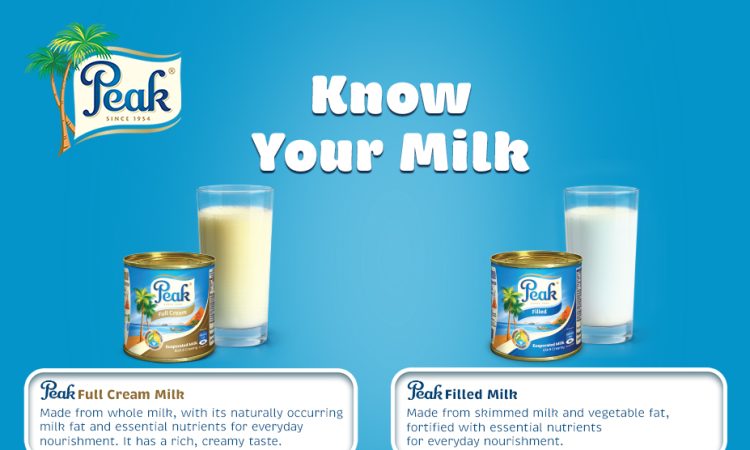
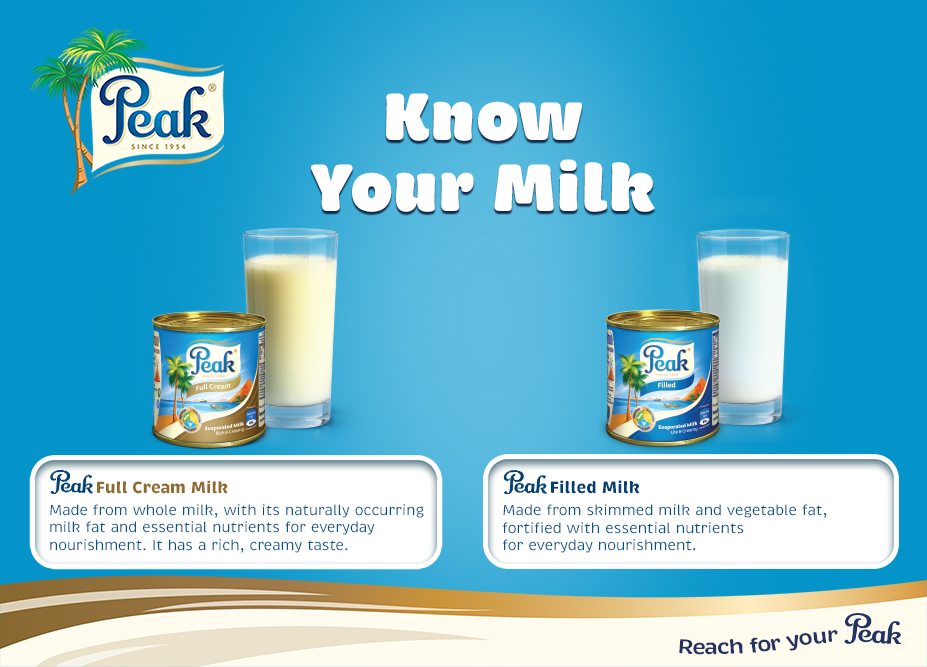
Made from whole cow’s milk, it naturally contains milk fat, giving it the rich, creamy taste many people enjoy. It also provides complete dairy nutrition by supplying high-quality protein, calcium and a range of essential vitamins and minerals that contribute to bone health, muscle function and overall wellbeing.
One example within this category is Peak Full Cream Milk, which is available in both powdered and evaporated formats. Its versatility makes it suitable for drinking, breakfast cereals, smoothies, tea, coffee, cooking and baking, making it a practical choice for everyday family use.
Best suited for: Families looking for complete dairy nutrition for everyday use.
Peak Filled Milk
Filled Milk is a dairy milk product in which part or all the natural milk fat has been replaced with vegetable oils. While this gives it a different fat composition from Full Cream Milk, it continues to provide important nutrients such as high-quality protein, calcium and essential vitamins. Peak Filled Milk offers consumers another dairy milk option that combines these nutritional benefits with a different fat composition to suit varying dietary preferences.
Rather than thinking of Filled Milk as “better” or “worse” than Full Cream Milk, it is more helpful to understand that each product has been developed to meet different consumer needs. The right choice depends on your nutritional requirements, health goals and personal preferences.
Best suited for: Consumers looking for a dairy milk option with a different fat composition.
Peak 456 Growing-Up Milk
Children have different nutritional needs at different stages of growth, which is why age-appropriate milk products have an important role in supporting a balanced diet.
Peak 456 Growing-Up Milk is specially formulated for children aged four to six years. In addition to providing high-quality protein and calcium, it is fortified with essential vitamins and DHA, an omega-3 fatty acid that supports normal brain development during childhood.
By providing nutrients tailored to this stage of growth, Peak 456 helps support the nutritional needs of young children as part of a healthy, balanced diet.
Best suited for: Children aged 4–6 years.
A Simple Guide to Choosing the Right Milk
Choosing the right milk doesn’t have to be complicated. Once you understand what each product is designed to do, the decision becomes much simpler.
If you’re looking for…
A suitable option is…
Complete dairy nutrition for the family
Peak Full Cream Milk
A dairy milk option with a different fat composition
Peak Filled Milk
Nutrition designed for children aged 4–6 years
Peak 456 Growing-Up Milk
Before adding any dairy milk product to your shopping basket, ask yourself three simple questions:
Which dairy milk do I need? Full Cream or Filled milk
Who am I buying this product for?
Does this product meet my nutritional needs and suit how I intend to use it?
Answering these questions can help you move beyond attractive packaging or familiarity and choose the product that best suits your needs and those of your family.
Choosing with Confidence
Standing in that supermarket, I realised the young couple weren’t looking for the “best” milk. They were looking for clarity.
Like many consumers, they simply wanted to understand the options available, and which one best suited their needs. Their questions weren’t unusual. They reflected the uncertainty many shoppers experience when faced with more choice than ever before.
The good news is that having more options isn’t a problem. In fact, it’s an advantage. The first step is to know that there is dairy milk and non- dairy milk.
For those who choose dairy milk, understanding the difference between Full Cream Milk, Filled Milk and age-appropriate milk products makes choosing the right option much easier.
The key is understanding the purpose of each product. Once we understand those differences, choosing milk becomes less about guesswork and more about making informed decisions for ourselves and our families.
After all, making informed nutrition decisions doesn’t begin when we pour milk into a cup. It begins with the knowledge and confidence to choose wisely. So, know your milk.